How to Integrate UPI Payment Gateway in a Website
A practical architecture guide to UPI payment gateway integration, website checkout flows, UPI QR, and where Dynamic UPI QR generation fits.
Published 2026-07-09 · 8 min readUPI Gateway Pro provides Dynamic UPI QR generation. It does not provide payment gateway services, process payments, settle funds, provide acquiring, or verify payment success by itself.
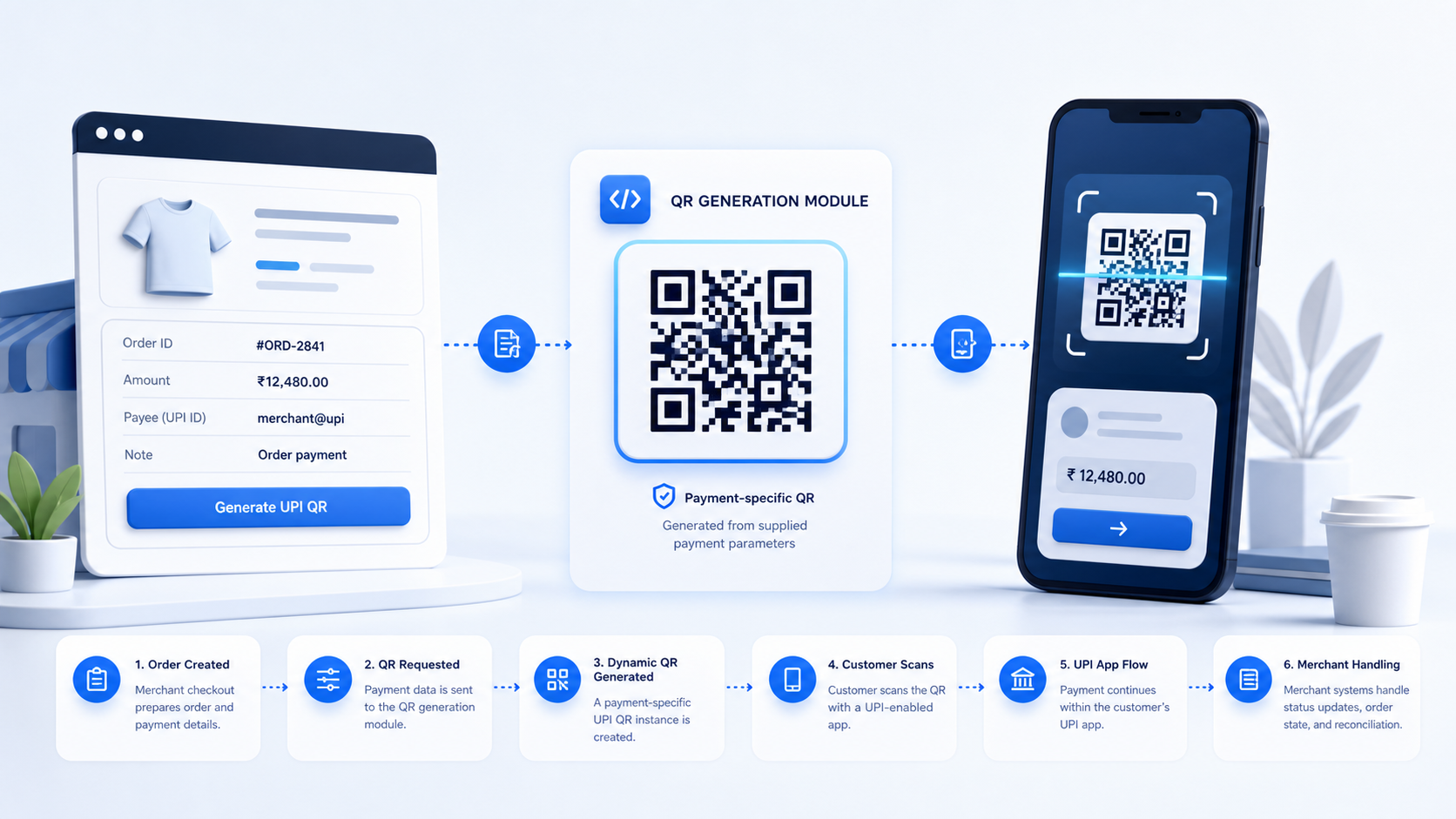
Integrating a UPI payment gateway in a website is not just a button or a QR code. A complete merchant payment flow usually includes checkout data, payment initiation, customer action, payment confirmation, order state management, settlement reporting, and customer support handling.
UPI Gateway Pro sits in one specific part of that wider architecture: Dynamic UPI QR generation. It can help generate payment-specific UPI QR data for a merchant flow, but it does not operate as a payment gateway, process payments, move funds, or settle merchant balances.
Typical website payment integration architecture
A website checkout normally starts by preparing an order reference, payable amount, customer-facing description, and merchant payment context. In a payment gateway integration, that data is sent to a gateway or payment service provider that manages payment initiation, callbacks, reconciliation, and settlement according to its own commercial and regulatory setup.
For QR-based UPI flows, the checkout may also need to display a QR code that the customer can scan with a compatible UPI app. If the QR is dynamic, it can be generated for a particular payment request rather than reused as a single static merchant identifier.
Where Dynamic UPI QR generation fits
Dynamic QR generation fits before the customer scan. The merchant flow prepares payment data, requests a QR instance, displays it on the website or order page, and then continues the payment journey through the merchant's connected UPI and financial infrastructure.
This distinction matters. A UPI payment gateway may provide payment processing, transaction callbacks, settlement files, dashboards, risk controls, and refund tooling. UPI Gateway Pro provides Dynamic QR generation infrastructure for merchant payment flows and should not be treated as the gateway of record.
Preparing payment parameters
Before requesting a Dynamic UPI QR, a merchant flow should know which payment data is relevant: order reference, amount, merchant UPI identifier or payee context, and customer-facing notes where supported by the flow. Teams should also decide how the checkout expires or refreshes QR instances and how order state is handled when the customer returns from a UPI app.
Payment confirmation boundaries
Payment confirmation should come from the merchant's payment gateway, banking, reconciliation, or verified internal order infrastructure. A QR generator can create the payment-specific QR data, but that does not prove a payment happened. Keep QR generation, payment initiation, confirmation, and settlement as separate layers in the design.
Implementation checklist
- Define the order states before payment, while QR is displayed, after customer action, and after confirmation.
- Make the Dynamic QR visible, scannable, and refreshable when the checkout expires.
- Use clear customer copy that explains the next action without claiming instant payment success.
- Keep reconciliation and settlement responsibility with the relevant payment and financial providers.
For a product-specific view, see Dynamic UPI QR generation and the full QR flow explanation.
For product context, use these companion pages:
Need Dynamic UPI QR generation?
Explore how UPI Gateway Pro can fit into a merchant payment flow without replacing your payment gateway or settlement infrastructure.